
|
|
|
|
contents: policy research and consultancy addresses selection of projects (recent and ongoing) selected list of publications personnel links
The nucleus of activity is in the area of evaluation, in particular where questions regard the relation between research (higher education) and the societal context. This implies alongside evaluation studies user and policy analysis. We research processes of knowledge production, knowledge transfer, diffusion, innovation and interaction with stakeholders and users. We have developed a special knowledge on issues relating to multi- and interdisciplinary research.
sci_Quest offers and develops customized methods for evaluation, including assessments protocols, and for the analysis of the broader research process. It covers a wide variety of quantitative and qualitative methods. sci-Quest believes that the combination of the two types of methods is essential for getting the most valuable results in policy related questions.
Our sectors of expertise are agricultural sciences, research for development (third world studies) and development policy, higher education, biotechnology, medicine and health research, environmental sciences, natural sciences, social sciences.
How
does sci_Quest work
sci_Quest
aims at assisting policy makers and research managers through problem oriented
and customized research and consultancy. To make sure that there is a close
relation between the problem of the customer and our work, we frequently
interact with the customer. Mutual understanding in the first phase of
any given project is often crucial for its success. At the start of a project,
we therefor offer a free round of advice, in order to get the problem straight.
If necessary, we will deliver a short ‘position’ paper. After that, we
work out one of the following arrangements:
arrangements
1.
Short term consultancy, based on desk research. Reports usually can be
delivered in a few weeks. (Fixed price)
2.
Mid-term research or consultancy. Some field research necessary. Reports
can be delivered in less than two months. (Price based on day fees)
3.
Long term research and consultancy. Full research project, including desk
and field research, taking up two months or more. Price arrangements vary,
depending on the size of the project and possible additional costs.
4.
Temporary arrangements for in-house positions with the customer ('detachering').
Price negotiable.*
* More detailed information on the arrangements and the activities of sci-Quest, and the conditions of delivery are obtainable at the email and fax numbers.

| Drs.
Frank J.M. Wamelink
University
of Amsterdam
email: wamelink@chem.uva.nl home-office:
|
Dr.
Jack B. Spaapen
office:
email: jbspaa@xs4all.nl |

April 1999, in collaboration with the VSNU (Organization of Dutch Universities) and the COS (platform for Sector Councils), Workshop on Evaluation of Societal Quality of Scientific Research
February 1999, De Evaluatie van Universitair Onderzoek. Methodiek voor het incorporeren van de maatschappelijke waarde van onderzoek. Publication commissioned by NRLO (Research Council for Agricultural Research) en COS (also available in English: 'The Evaluation of Universitary Research. The incorporation of the societal value of research')January 1999, North-South Research Partnerships, study commissioned by the RAWOO (Research Council for research on development countries)
September 1998 Design and co-ordination of a new curriculum 'Management,Policy and Biology' commissioned by the Faculty Biology, University of Amsterdam

July 1998, Assessment of the embeddement and performance of 12 agricultural research programs in the societal and scientific environment. Additional study in support of the self evaluation of 12 research programs of the Agricultural University Wageningen, Study and report, commissioned by Wageningen Agricultural University, co-financed by NRLO and COS.
September 1997, Science and technology in a developing world, international research project, (book co-edited by Terry Shinn - CNRS Paris, and Venni Krishna - NISTADS New Delhi, published by Kluwer Academics) book and conference (in Paris, september 1994) sponsored by DGIS (Dutch ministry of development cooperation) June 1997, Quantitative Analysis as part of broader feasibility study to find a method for systematically assessing the quality of Dutch agricultural R&D infrastructure: see publications: Een kwantitatieve analyse van de bodembiologie in Nederland, werkdocument NRLO t.b.v: 'Methode voor Kwaliteitsbeoordeling van de Agro-kennisinfrastructuur. Een haalbaarheidsanalyse op basis van 3 case studies', NRLO-Rapport nr. 97/23, 1997, door: TNO-STB (contains English summary) October 1996, 'Samenwerking tussen disciplines ten behoeve van ontwikkelingsvraagstukken, aanknopingspunten voor beleid', study commissioned by the RAWOO, published in: 'Multi- en interdisciplinair onderzoek, verslag van een workshop', COS, Den Haag, 1996October 1996, 'Strategische evaluatie van Natuurkundig onderzoek in Nederland. Een conceptueel kader voor het ontwerp van performance indicatoren'. Discussienota voor de FOM (Research Council for Natural Science Research), sci_Quest, 23p.

June 1996, Evaluation of Effects of Research on Policy and Management, development of an evaluation protocol, commissioned by Tropenbos Foundation
May 1996, 'Multiple scattering" en localisatie van licht: Ontwikkeling van een kennisinfrastructuur?', study commissioned by FOM. (CD-rom presentation for FOM and STW-bureau, Utrecht, 6 May 1996).
An example:Comprehensive research evaluation
Research programs are primary units of production and are assessed as such. They do not necessarily operate in a comparable manner. Some programs may be mainly oriented toward the scientific community, others may be more geared toward industry of (inter)national policy. Most likely, programs will show a mixture of orientations. In other words, programs position themselves in a multiplicity of contexts and develop a variety of strategies to adapt to changes in the environment. Resources, personnel, available instruments, opportunities, research-goals, etc. are all strategically managed by the programs in order to create optimal conditions for survival and growth. The tool we developed to assess this process (REPP, see below) charts a number of key aspects of the research endeavor with regard to particular orientations or domains for research and development. The aim is to combine the different domains that are relevant for a program in a balanced and comparable manner, and thus be able to present various types of research programs that may have evolved, and understand their actions. The idea is that research group may appear as different types, based on legitimate choices made. Assessment of these variations can then take place in a manner that considers both the differences in orientation between programs and allows for comparison.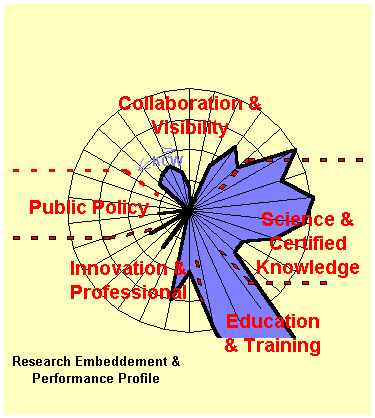
This an example of the comprehensive assessment tool we have developed for context-oriented research evaluation. We refer to it as REPP, which stands for 'research embeddement and performance profile'. The REPP offers a comprehensive view on the relations of a research group with the societal environment, and it also assesses the performance of the group in these various contexts. Five domains are distinguished. For each, a variety of quantitative and qualitative indicators are developed and calculated. Together, the scores of the individual indicators represent a domain, in the chart pictured as 'leaves'. These leaves together portray an image of the complex of activities of a research group.Starting at twelve o'clock going clockwise the following domains are represented: 1.Collaboration and visibility; 2. Science and Certified Knowledge; 3. Education and training; 4. Innovation and professionals; and 5. Public Policy. Each sector is a compilation of a number of relevant indicators (decided on grounds of literature and the specific policy question). For example, ‘Science and Certified Knowledge’ is made up by a cluster of indicators indicating publication activity and impact, but also strategic orientation of group members. In 'Public policy' interaction with the policy arena, mobility and funding are the basis of indicators. The goal of the REPP is to find the most representative set of indicators for each domain, thus eventually giving a representative picture of the group's activities as a whole. A more detailed description of the method is available on request.
The senior staff of sci_Quest consists of two people, CV's are given below. Further, sci_Quest cooperates on a regular basis with a number of consultants and academics, who are chosen per project on the basis of their specific expertise. Since reports are published either in Dutch or in English, sci_Quest has editorial expertise in both languages.
Drs. Frank J.M. Wamelink
Graduated in the University of Amsterdam in philosophy and science dynamics on a double thesis, in which the results were presented of a research project conducted for the Dutch Health Council (Gezondheidsraad). It entailed on the one hand the mapping radiotherapeutical research in the Netherlands, on the other sociological and philosophical implications of this project. Following graduation a number of projects in science policy were carried out as a freelancer. An inventory of Health research in the Netherlands was made and the networks of science-policy in this field were analysed (commissioned by Council for Health Research (Raad voor Gezondheidsonderzoek). A bibliometric analysis was conducted of Dutch physics research under a new financial regime in the Netherlands (in behave of the Foundation for Fundamental Research on Matter, FOM).
A Ph.D. project was taken on regarding the emergence of biotechnology in the Netherlands (Science Dynamics department, University of Amsterdam). As a Ph.D. student participated in various projects for Dutch science policy, and in international projects (e.g. a project of the National Science Foundation (USA) "Dynamic Structures of Science: Journal-Journal Citation Methods".) Co-designed and co-organized a new educational program "Science, Technology and Culture" (started in 1994-1995). Managed the new curriculum. Recently an advanced course for biology students was developed ('Management, Policy and Biology').Present-day projects and occupations:
1. Sci-Quest:
Consulting on science policy, conducting policy research currently with a focus on the evaluation of research (see above)2. Science Dynamics department:
Lecturer 'Management, Policy and Biology' (Maatschappelijke Biologie), Study-advisor/co-ordination: Personal advise to students concerning their curriculum, future perspectives, counseling, educational administration, regulations and law, study-guides, student enrollment and public relations, etc.
Dr. Jack B. Spaapen
Trained as a sociologist and cultural anthropologist at the University of Amsterdam. Ph.D. in science and technology studies. Previously worked as a researcher in a commercial bureau for industrial marketing research in Amsterdam, in a government office for urban planning in Lelystad, and at the University of Amsterdam in two different interdisciplinary departments, one in the field of science and technology studies, the other in development studies. Main fields of interest and specialization: Research Evaluation, in particular methods for the assessment of multidisciplinary research; Research Policy (at all levels of the research system); Development Research Policy. Other relevant experience: various editorial positions: a journal on science, technology and society; a daily internet paper, and (international) scientific publications.There have been three career stages so far. First, as an independent researcher and policy consultant in the area of construction and urban planning (between 1978 and 1983). Second, as a lecturer and researcher in two university departments of the University of Amsterdam (between 1983 and 1995). Third, as a senior partner in sci_Quest (the present).
The present work is to a large extent a continuation of the policy oriented work conducted in the academic period, but now in a commercial context. It builds on methods of policy information and evaluation developed in academia, but made to fit in an applied context. Main activities are marketing and acquiring of new projects, conducting research, developing new methods, organizing projects, editorial work.
still under construction